
Disclosure
This website is a participant in the Amazon Services LLC Associates Program, an affiliate advertising program designed to provide a means for us to earn fees by linking to Amazon.com and affiliated sites.
Choosing the right mattress topper involves balancing cost and comfort. Investing in key features can transform your sleep without the expense of a new mattress.
Not all premium features deliver equal value. Focus on materials and construction that target your specific needs, like pressure relief or temperature regulation, for a worthwhile upgrade.
Are You Waking Up Achy and Unrested Despite a “Good” Mattress?
Your mattress may feel firm and supportive at first, but pressure points build through the night, leading to stiffness. The SHOUREN 5 Inch Memory Foam Topper solves this by contouring precisely to your body, cradling hips and shoulders to relieve pressure and promote proper spinal alignment for truly restorative sleep.
For transformative comfort and support, we recommend: SHOUREN 5 Inch Memory Foam Mattress Topper
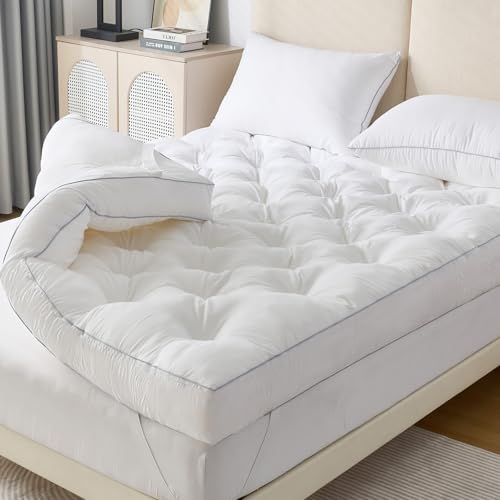
- 【5-Inch Extra Thick Comfort & Support】 SHOUREN mattress topper features a...
- 【Ergonomic Body-Contour Design】 Engineered to naturally fit your body...
- 【Upgraded 4-Way Elastic Anchor Straps】 Equipped with strong elastic straps...
Core Material Quality: The Foundation of a Good Mattress Topper
The material of your topper is the most critical factor for value. High-quality materials directly impact durability, comfort, and support over time. This is where your investment truly pays off.
Memory Foam Density and Certifications
For memory foam toppers, density is a key indicator of quality and longevity. Higher density foam provides better contouring and lasts longer without sagging. Look for a density of at least 4 pounds per cubic foot for a worthwhile purchase.
- CertiPUR-US® Certified: This ensures the foam is made without harmful chemicals and has low VOC emissions for better indoor air quality.
- Open-Cell Structure: Advanced foams use this design to improve airflow and reduce heat retention, a common complaint with traditional memory foam.
- Responsive Layers: Some toppers combine a slow-responding memory foam layer with a quicker-response support layer for balanced comfort and ease of movement.
Natural Latex vs. Synthetic Blends
Latex toppers offer excellent resilience and cooling, but material source affects price and performance. Natural latex is derived from rubber trees, while blended or synthetic versions are more affordable.
Natural latex is highly durable, naturally hypoallergenic, and offers superior breathability. It is a premium feature worth the money for sleepers seeking an eco-friendly, long-lasting option with responsive support.
Specialized Support Features for Targeted Relief
Beyond basic comfort, advanced support features solve specific sleep problems. These targeted technologies justify a higher price by directly addressing pain points like pressure and alignment.
Zoned Support Systems for Spinal Alignment
Zoned or ergonomic toppers have firmer sections in the lumbar and shoulder areas. This design promotes proper spinal alignment by providing differential support where your body needs it most. It is a valuable feature for back and side sleepers with chronic pain.
- Lumbar Reinforcement: Extra support in the lower back area helps prevent sagging and maintains the natural curve of your spine throughout the night.
- Softer Shoulder Zones: These allow shoulders to sink in slightly for side sleepers, reducing pressure on joints and improving circulation.
- Firmer Hip Sections: This prevents the hips from sinking too deeply, which can misalign the spine and cause lower back discomfort.
Cooling Technology Investments
If you sleep hot, investing in active cooling features can be Effective. Standard materials often retain body heat, but advanced technologies work to dissipate it.
Look for toppers infused with gel beads, graphite, or phase-change material. These substances actively pull heat away from the body. A breathable, moisture-wicking cover, such as one made from bamboo or Tencel, further enhances this cooling effect for a worthwhile upgrade.
| Feature | How It Works | Best For |
|---|---|---|
| Gel-Infused Foam | Gel beads conduct heat away from the surface. | Memory foam users who need moderate cooling. |
| Graphite Infusion | Graphite layers absorb and distribute body heat. | Sleepers seeking consistent temperature neutrality. |
| Breathable Tencel Cover | Natural fibers wick moisture and promote airflow. | All sleeper types as a complementary layer. |
Practical Construction and Long-Term Value
Durable construction and user-friendly design ensure your topper remains a valuable asset. These practical features impact daily use and determine how long your investment will last.
Mattress Topper Cover Quality and Removability
A high-quality, removable cover is essential for hygiene and protection. It shields the core material from spills, dust mites, and general wear. A well-constructed cover with a reliable zipper is a sign of a product built to last.
- Machine-Washable Fabric: This allows for easy cleaning, extending the topper’s lifespan and maintaining a fresh sleep surface. Look for covers made from cotton, bamboo, or moisture-wicking blends.
- Strap or Anchor Systems: Elastic bands or fitted skirt anchors keep the topper securely in place on your mattress. This prevents slipping and bunching, which can disrupt sleep and damage the topper.
- Quilted or Padded Layers: Some covers include a thin layer of padding or quilting for added plushness and to protect the core material from compression.
Warranty and Trial Period Considerations
A strong warranty and sleep trial are non-negotiable for a premium purchase. They are direct indicators of the manufacturer’s confidence in their product’s durability and your satisfaction.
A warranty of at least 3-5 years protects against premature sagging or material defects. More importantly, a risk-free trial period of 90 nights or more allows you to truly test the topper’s comfort and support in your own home, ensuring it meets your specific needs before committing fully.
- Inspect the cover’s zipper and stitching for durability.
- Verify the wash instructions for the cover are practical.
- Read the warranty’s fine print regarding coverage for sagging depth (often 1-1.5 inches).
- Confirm the return policy includes free return shipping or low restocking fees.
Matching Topper Features to Your Sleep Position
The most valuable features depend directly on how you sleep. A topper that perfectly complements your sleep position provides targeted comfort and corrects mattress shortcomings.
Best Topper Features for Side Sleepers
Side sleepers need pressure relief at the shoulders and hips. A topper that is too firm can cause joint pain, while one that is too soft fails to support spinal alignment.
- Plush to Medium Firmness: Look for contouring materials like memory foam or soft latex that cushion the shoulders and hips while filling the waist gap.
- Deep Contouring: A topper with a thicker profile (3-4 inches) allows for adequate sinkage to relieve pressure points without bottoming out.
- Zoned Support: , a topper with softer shoulder zones is particularly beneficial for maintaining neutral spine alignment in this position.
Ideal Support for Back and Stomach Sleepers
Back and stomach sleepers require firmer support to prevent the midsection from sinking. This sinking can cause the spine to curve unnaturally, leading to lower back pain.
A medium-firm to firm topper made from resilient latex or high-density foam is ideal. It provides the necessary push-back to keep the hips elevated and spine straight. For these positions, a thinner profile (2-3 inches) is often sufficient to add comfort without sacrificing the mattress’s inherent support.
| Sleep Position | Priority Feature | Recommended Material & Firmness |
|---|---|---|
| Side Sleeper | Pressure Relief at Hips/Shoulders | Memory Foam or Soft Latex (Plush) |
| Back Sleeper | Lumbar Support & Even Surface | Latex or HD Foam (Medium-Firm) |
| Stomach Sleeper | Prevent Midsection Sinkage | Firm Latex or HD Foam (Firm) |
| Combination Sleeper | Responsiveness & Ease of Movement | Responsive Latex or Gel Foam (Medium) |
Smart Shopping: Avoiding Overpriced and Unnecessary Features
Not every premium add-on delivers proportional value. Discerning which features are marketing hype versus genuine innovations is key to spending wisely on a mattress topper upgrade.
Identifying Marketing Hype vs. Real Innovation
Some terms sound impressive but offer little practical benefit. Be skeptical of vague claims like “clinical grade” or “NASA-inspired” without specific material or construction details to back them up.
- Excessive Thickness: A topper thicker than 4 inches can often feel unstable and may not stay properly anchored. For most sleepers, 2 to 3 inches provides the ideal balance of comfort and support.
- Unverified Health Claims: Features touted for “magnetic therapy” or “far-infrared” benefits typically lack scientific support for sleep improvement. Focus on proven aspects like pressure relief and temperature regulation instead.
- Proprietary Names for Common Materials: A uniquely branded foam is often standard polyurethane or memory foam. Always check for independent certifications like CertiPUR-US® for verification of quality and safety.
When to Skip the Topper and Replace the Mattress
A topper is a solution for minor comfort issues, not a failing foundation. Investing in premium topper features is not worthwhile if your underlying mattress is severely compromised.
If your mattress is over 8 years old, has significant sagging or body impressions deeper than 1.5 inches, or causes persistent pain that a firm surface doesn’t alleviate, the core support system has likely failed. In these cases, the money is better allocated toward a new mattress that provides proper foundational support from the start.
- Claims that sound too good to be true (e.g., “cures insomnia”).
- Lack of transparent material specifications and density ratings.
- No sleep trial or a warranty shorter than 2 years.
- An extremely high price point that nears the cost of a quality budget mattress.
Final Decision Framework: Prioritizing Your Investment
With so many options, a clear decision-making framework helps you allocate your budget effectively. Prioritize features that solve your biggest sleep problem first for the greatest return on investment.
Creating a Personal Feature Priority List
Start by identifying your primary sleep complaint. Rank potential topper features based on their ability to solve this specific issue, rather than getting distracted by less relevant add-ons.
- Define Your Main Goal: Is it cooling, pressure relief, firmness adjustment, or allergy reduction? Your top-ranked feature should directly address this.
- Set a Firm Budget: Determine your maximum spend. This will immediately narrow your choices and force you to compare the value of features within your price range.
- Compare Top Contenders: Filter options by your top 1-2 priority features. Read verified customer reviews focusing on how the topper performed for your specific sleep need.
Balancing Cost with Expected Lifespan
A higher upfront cost can be justified by a longer usable life. Calculate the cost-per-year by considering the product’s expected durability and warranty length.
For example, a $200 topper with a 5-year warranty has a cost of $40 per year. A $100 topper that sags after one year costs $100 per year. Investing in durable materials and construction often provides better long-term value, making the premium features truly worth the money.
| Primary Sleep Goal | Feature Priority #1 | Feature Priority #2 | Budget Allocation Tip |
|---|---|---|---|
| Stay Cool | Cooling Infusion (Gel/Graphite) | Breathable, Moisture-Wicking Cover | Invest here first; standard foam will disappoint. |
| Relieve Back Pain | Zoned Support or Firm Density | Responsive Material for Alignment | Don’t sacrifice support for excessive plushness. |
| Soften a Firm Mattress | Plush Material (Soft Latex, Memory Foam) | Adequate Thickness (2-3 inches) | Material quality matters more than extreme thickness. |
| Reduce Allergens | Hypoallergenic Material (Natural Latex) | Removable, Washable Cover | Certifications and washability are non-negotiable. |
Is a Cooling Topper Worth the Extra Money?
For hot sleepers, absolutely. Standard memory foam and some latex can retain body heat, disrupting sleep. Investing in active cooling technology directly addresses this core issue.
- Yes, if you sleep hot: Gel infusions, graphite, or phase-change materials actively regulate temperature, making them a high-value purchase for your comfort.
- Consider your climate: If you live in a warm area or your bedroom lacks climate control, this feature provides significant nightly relief.
- Alternative: A breathable wool or cotton topper can also offer temperature regulation at a potentially lower cost, though with less active cooling.
How Much Should I Spend on a Quality Mattress Topper?
A good benchmark is between $100 and $300. Prices below $100 often indicate lower-density materials that may sag quickly. Prices exceeding $400 may overlap with the cost of a new budget mattress.
Within that range, expect to pay more for natural materials like Talalay latex, high-density memory foam (4lbs+), and integrated zoned support systems. These features correlate directly with increased durability and targeted comfort, justifying the spend.
What is the Most Important Feature for Back Pain?
The single most important feature for back pain is supportive firmness that maintains spinal alignment. A topper that is too soft will allow your hips to sink, creating an unnatural curve in your spine.
Look for a medium-firm to firm topper with good responsiveness. Materials like dense memory foam or latex provide the necessary push-back. For targeted relief, a topper with ergonomic zoning that reinforces the lumbar area offers exceptional value for back pain sufferers.
- Does it solve my #1 sleep complaint (e.g., heat, pressure, firmness)?
- Is the material density or quality clearly stated and reputable?
- Is there a sleep trial of at least 90 nights to test it risk-free?
- Does the warranty cover sagging below a defined depth (e.g., 1 inch)?
Best Recommended Mattress Toppers for Key Features
Based on the valuable features discussed, here are three top-rated options that excel in specific areas. Each represents a smart investment for different sleep needs and priorities.
Zalmureta 4 Inch Dual Layer Memory Foam Mattress Topper – Best for Deep Pressure Relief
This topper combines a soft, breathable top layer with a firmer support base for excellent contouring. The 4-inch profile is ideal for side sleepers needing cushioning for hips and shoulders, and it includes a removable, washable cover for easy maintenance.
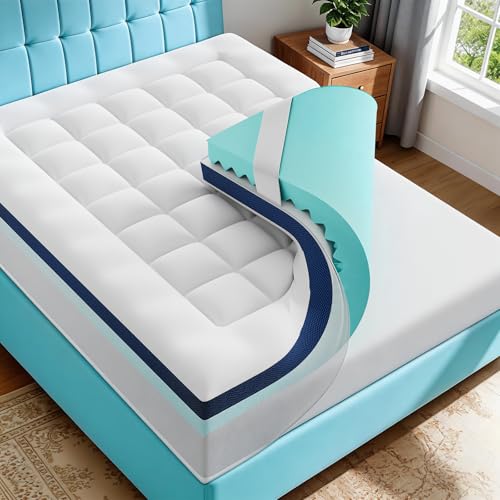
- 【4-Inch Dual-Layer Design】Our mattress topper features a 2-inch cooling...
- 【Breathable Design】This mattress topper is designed with Cold Gel Memory...
- 【Effective Body Support】Our mattress topper are ergonomically designed with...
SINWEEK Mattress Topper Twin XL – Best Budget-Friendly Cooling Option
An ideal choice for hot sleepers on a budget, this topper features gel-infused memory foam to dissipate heat. It provides a medium-firm feel suitable for various sleep positions and comes with elastic straps to secure it to the mattress, preventing slippage.

- GEL MEMORY FOAM MATERIAL: Our memory foam mattress topper readily conforms to...
- MORE COMFORTABLE SLEEP: The gel memory foam material used in our mattresses...
- SOFT BUT NOT FOLDABLE: our mattress is soft, do not roll up and store too long...
ChiXpace Dual Layer 4 Inch Memory Foam Mattress Topper – Best for Support and Alignment
This model offers a dual-layer design with ergonomic zoning, providing targeted support for the lumbar and leg areas. It is an excellent option for back sleepers or anyone needing to improve spinal alignment on a too-soft mattress, featuring a CertiPUR-US certified foam core.
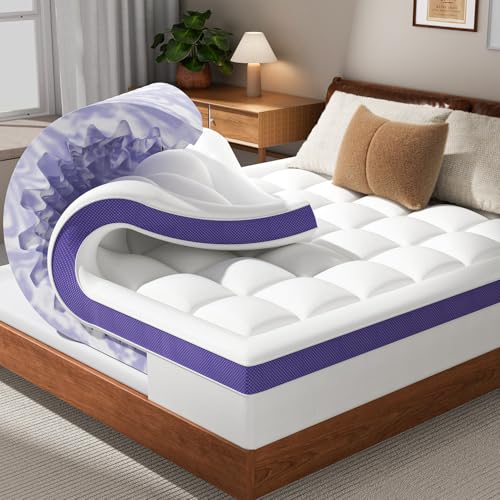
- Dual-Layer Design: This is Queen (60" x 80") size mattress topper. Our mattress...
- Comfortable Support: The memory foam with an egg-crate pattern provides...
- Cooling & Breathable: The ultra-soft fabric and premium gel-infused memory foam...
Conclusion
Determining which mattress topper features are worth the money ultimately depends on your unique sleep needs and budget. The most valuable investments directly solve your primary comfort issue, whether it’s cooling, pressure relief, or support.
Prioritize high-quality materials, durable construction, and features that target your specific sleep position. By focusing on these core elements, you can transform your sleep experience without the expense of a new mattress, ensuring your purchase delivers lasting comfort and value.
Frequently Asked Questions about What Topper Features Are Worth The Money
What is the most important factor when choosing a mattress topper?
The most critical factor is the core material quality and density. High-density foams and natural latex last longer and provide better support than cheaper, low-density alternatives. This foundation determines durability and overall comfort.
Your primary sleep goal, such as cooling or pressure relief, should guide which premium features you prioritize on top of this quality foundation. Investing in a good base material is non-negotiable for value.
Is a 4-inch topper always better than a 2-inch topper?
Not necessarily. Thickness should match your need for cushioning. A 4-inch topper is better for deep contouring and pressure relief, ideal for side sleepers. A 2-inch topper is sufficient for slightly softening a firm mattress.
A thicker topper made from poor-quality material will sag quickly. A thinner topper made from high-density material often provides better support and represents a smarter investment for many sleepers.
Are cooling mattress toppers really effective?
Yes, advanced cooling features like gel infusions, graphite, and phase-change materials are effective at dissipating body heat. They make a significant difference for hot sleepers compared to standard memory foam, which tends to retain heat.
For maximum effect, pair a cooling topper with breathable, moisture-wicking bedding. This combination tackles heat retention from both the surface and the material below, providing a noticeably cooler sleep environment.
How long should a good quality mattress topper last?
A high-quality topper with good material density should last between 3 to 5 years with proper care. Natural latex toppers can often last 5 years or longer due to their inherent durability and resilience.
The lifespan is heavily influenced by the topper’s weight limit and regular maintenance. Using a protective cover and rotating the topper periodically can help prevent premature sagging and extend its usable life.
Can a mattress topper fix a sagging mattress?
No, a topper cannot fix a structurally sagging mattress. It can only mask minor firmness issues or add a comfort layer. If your mattress has deep body impressions or broken springs, the underlying support is compromised.
Adding a topper to a severely sagging mattress can even create an unstable, hammocking effect. In this case, the money is better spent on replacing the old mattress entirely for proper spinal support.
Is it worth paying extra for a topper with a warranty?
Yes, a strong warranty is a key indicator of a worthwhile purchase. A warranty of at least 3 years shows the manufacturer stands behind the product’s durability against defects like premature sagging.
Always read the warranty details, specifically the sagging depth coverage (often 1 to 1.5 inches). A good warranty protects your investment and provides peace of mind, making a slightly higher price tag justifiable.