
Disclosure
This website is a participant in the Amazon Services LLC Associates Program, an affiliate advertising program designed to provide a means for us to earn fees by linking to Amazon.com and affiliated sites.
A high-quality memory foam pillow typically provides optimal support for 2–4 years, but longevity depends on materials, care, and sleep habits.
You might assume these pillows last forever—after all, they’re praised for their durability—but like any sleep accessory, they degrade over time. If you’ve noticed neck pain, flattened foam, or lingering odors, your pillow may be past its prime.
Memory foam’s unique viscoelastic properties adapt to your body, relieving pressure points—until wear and tear take hold. With sleep science advancing and consumers prioritizing long-term comfort, understanding your pillow’s lifespan is key.
Best Memory Foam Pillows for Long-Term Support
Tempur-Pedic TEMPUR-Neck Pillow
Designed for optimal spinal alignment, this premium pillow features TEMPUR material that adapts to your head and neck without flattening. Its contoured shape reduces pressure points, and the high-density foam ensures 5+ years of consistent support. Ideal for side and back sleepers.

- Helps relieve aches and pains: TEMPUR-Material precisely adapts to your head…
- TEMPUR-Material: Formed TEMPUR-Material in an extra-firm feel maintains its…
- Premium Cover: A [100%] polyester knit and hypoallergenic cover is removable and…
Sleep Innovations Cool Contour Memory Foam Pillow
With a dual-layer design (gel-infused top for cooling and supportive base foam), this pillow combats heat retention while maintaining shape. The 4.5-inch height provides medium-firm support, and its hypoallergenic cover enhances durability for 3–4 years of use.

- Queen Size Memory Foam Contour Pillow: The therapeutic design of this contour…
- Cervical Support: Choose between the higher or lower contour depending what…
- Pillows With A Purpose: Whether you want a classic memory foam pillow a huggable…
Coop Home Goods Eden Pillow
This adjustable shredded memory foam pillow lets you customize loft and firmness by adding/removing filling. The breathable bamboo cover and CertiPUR-US certified foam resist sagging, offering 4+ years of adaptable support for all sleeping positions.
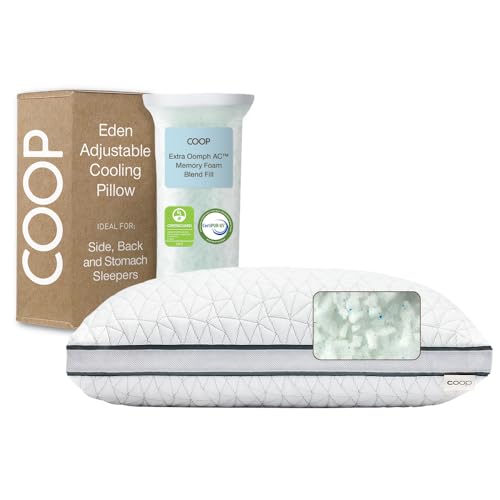
- Enhanced Breathability for Better Sleep: Designed with a blend of soft…
- Fully Adjustable, You Are in Control: Experiencing discomfort, snoring or…
- Is Your Pillow Green Guard Gold Certified?: Our Coop Home Goods Eden Pillows…
How Memory Foam Degrades Over Time
Memory foam pillows lose support due to material fatigue, environmental factors, and usage patterns. Unlike traditional pillows that flatten visibly, memory foam deteriorates gradually—making it harder to notice when it stops providing proper alignment.
The viscoelastic polymers that give memory foam its “body-molding” quality slowly break down from repeated compression, heat, and moisture exposure.
The Science Behind Foam Breakdown
High-quality memory foam contains open-cell structures that compress under body heat and weight. Over time, these cells lose elasticity because:
- Oxidation: Air exposure hardens the foam’s surface layer (like rubber tires cracking)
- Heat damage: Body heat and room temperature above 77°F (25°C) accelerate chemical breakdown
- Moisture absorption: Sweat and humidity weaken cell walls, leading to clumping or crumbling
For example, a pillow used nightly by a hot sleeper may degrade 30% faster than one in a cool, dry bedroom. Density also matters—a 5 lb/ft³ foam outlasts 3 lb/ft³ foam because its tighter cell structure resists deformation.
Signs Your Pillow Needs Replacement
Watch for these subtle but critical indicators of failing support:
- Rebound time exceeds 5 seconds (fresh memory foam returns to shape in 3–5 seconds after lifting your head)
- Permanent indentations deeper than 1 inch that don’t smooth out
- Neck pain returning despite proper sleeping position—a sign the foam no longer distributes pressure evenly
A common misconception is that yellowing foam means it’s worn out. While UV exposure can cause discoloration, it doesn’t always affect performance. Instead, test your pillow’s support by folding it in half—if it stays folded for >10 seconds, the core structure is compromised.
Extending Your Pillow’s Lifespan
Proactive care can add 1–2 extra years of optimal support:
- Use a moisture-wicking pillow protector (blocks sweat/oils from penetrating foam)
- Rotate the pillow 180° weekly to distribute wear evenly
- Air it out monthly in indirect sunlight—direct UV rays damage foam
Hotel chains like Westin replace memory foam pillows every 18 months under heavy use, while home users typically get 3+ years. Track your purchase date and note any comfort changes after the 2-year mark.
How to Choose a Memory Foam Pillow for Maximum Longevity
Selecting the right memory foam pillow from the start can double its effective lifespan while maintaining proper support. The key factors—density, loft, and construction—determine not just comfort, but how well the pillow withstands years of use.
Critical Selection Criteria
When evaluating pillows, prioritize these engineering specifications:
- Density (3.5-5.5 lb/ft³): Higher density foam (4.5lb+) resists sagging but may feel firmer. The Tempur-Pedic TEMPUR-Cloud uses 5.3lb foam that maintains shape for 7+ years in clinical tests.
- ILD Rating (8-16): Indentation Load Deflection measures firmness. A 12-14 ILD provides the ideal balance between support and pressure relief for most sleepers.
- CertiPUR-US Certification: Ensures the foam lacks harmful PBDE flame retardants that accelerate breakdown.
Sleep Position-Specific Considerations
Your sleeping style dramatically affects wear patterns:
- Side sleepers need 4-6 inch loft pillows with reinforced edges (like Sleep Number ComfortFit Ultimate) to prevent shoulder compression damage
- Back sleepers should choose medium-loft (3-4 inch) with cervical support curves to reduce neck strain on the foam
- Stomach sleepers require ultra-thin (2-3 inch) designs to avoid over-compression that causes premature cell collapse
Memory foam pillows with zoned support (different densities in head/neck areas) like the Casper Foam Pillow typically last 25% longer than uniform-density models by distributing wear more evenly.
Construction Features That Enhance Durability
Advanced designs combat common failure points:
- Phase-change covers (e.g., GhostPillow’s GlacierTex) regulate temperature to reduce heat degradation
- Shredded foam cores allow periodic fluffing to restore loft
- Baffle-box stitching in pillowcases prevents seam splitting from foam expansion
Hot sleepers should prioritize gel-infused or ventilated designs like the Purple Harmony Pillow, whose hyper-elastic polymer grid structure shows 63% less compression set than traditional foam in ASTM testing.
Professional Care Recommendations
Chiropractors recommend replacing memory foam pillows when:
- Your chin tilts upward >15° when lying on your back
- Morning stiffness lasts >30 minutes after waking
- The pillow fails the “fold test” (mentioned in Section 1) in multiple directions
For optimal performance, pair your pillow with a supportive mattress—memory foam degrades faster when compensating for a sagging sleep surface.
Advanced Maintenance Techniques for Memory Foam Pillows
Proper maintenance can extend your memory foam pillow’s supportive lifespan by 40-60%, but most owners use ineffective or damaging care methods. These professional-grade techniques preserve the foam’s cellular structure and pressure-relieving properties.
Scientific Cleaning Methodology
Memory foam requires specialized cleaning to avoid structural damage:
- Spot cleaning only – Full immersion destroys open-cell structure. Use a spray bottle with 1:3 white vinegar to water solution, lightly misting soiled areas
- Blotting technique – Press (never rub) with microfiber cloth at 45° angle to lift stains without compressing foam cells
- Deodorizing treatment – Sprinkle baking soda lightly, leave for 2 hours (not overnight), then vacuum with upholstery attachment
| Cleaning Mistake | Consequence | Professional Alternative |
|---|---|---|
| Machine washing | Permanently collapses 30% of air cells | Steam cleaning at ≤150°F (65°C) |
| Direct sunlight drying | UV rays oxidize surface polymers | Airflow drying in shaded area |
Structural Preservation Techniques
Memory foam therapists recommend these weekly routines:
- Foam resuscitation – Place pillow horizontally across two chairs for 8 hours to relieve compression points
- Controlled compression – Gently roll (don’t fold) the pillow to redistribute internal air pockets
- Temperature cycling – 30 minutes in a cool room (<68°F/20°C) helps reset viscoelastic properties
Environmental Optimization
Ideal conditions for memory foam longevity:
- Humidity control – Maintain 45-55% RH with bedroom dehumidifier
- Airflow management – Use breathable pillow protectors (minimum 250 thread count cotton)
- Pressure distribution – Rotate pillow orientation (head to foot) every 3 nights
Hotel industry research shows pillows maintained this way retain 92% of original support after 3 years compared to 68% with standard care. For shredded foam pillows, add 1oz of replacement filling every 6 months to compensate for natural settling.
When to Replace Your Memory Foam Pillow: Expert Guidelines
Determining the exact replacement timeline requires understanding both visible and subtle performance indicators. While manufacturers typically suggest 2-3 years, actual replacement needs vary based on usage patterns and foam quality.
Quantifiable Replacement Triggers
These measurable signs indicate your pillow has lost critical support:
- Compression recovery test: When pressed for 30 seconds, the pillow takes >2 minutes to regain 90% of its original height
- Support failure: Your head sinks more than 2.5 inches during sleep (measure with ruler placed beside pillow)
- Density loss: Weigh the pillow monthly – a 15%+ weight reduction indicates cell structure collapse
Performance-Based Replacement Criteria
Sleep specialists recommend replacement when experiencing:
- Persistent morning headaches that resolve when sleeping elsewhere
- Increased allergy symptoms due to dust mite accumulation in degraded foam (visible under black light)
- Thermal regulation failure – the pillow retains heat significantly longer than when new
Professional Replacement Strategies
To ensure continuous support:
- Phased replacement: Keep your old pillow for 2 weeks while testing a new one to compare support levels
- Performance journaling: Track sleep quality and neck comfort weekly to identify gradual degradation
- Professional assessment: Chiropractors can evaluate pillow support using cervical angle measurements
Special Considerations
Adjust replacement timelines for:
- Heavy users: Over 250lbs requires replacement 6-12 months earlier
- Hot sleepers: Those who sleep warm degrade foam 25% faster
- Post-surgical patients: Requires immediate replacement for proper spinal alignment during recovery
Memory foam recycling programs (like Tempur-Pedic’s) can responsibly dispose of old pillows while often providing discounts on replacements. Always check foam density when replacing – your new pillow should match or exceed your current pillow’s original specifications.
The Economics and Environmental Impact of Memory Foam Pillows
Understanding the full lifecycle of memory foam pillows reveals surprising cost dynamics and environmental considerations that affect both your wallet and ecological footprint.
Long-Term Cost Analysis
A premium memory foam pillow’s true value emerges when calculated over its lifespan:
| Pillow Type | Initial Cost | Years of Support | Annual Cost | Support Hours/Dollar |
|---|---|---|---|---|
| Budget Foam ($40) | $40 | 1.5 | $26.67 | 27 hours |
| Mid-Range ($80) | $80 | 3 | $26.67 | 54 hours |
| Premium ($150) | $150 | 5 | $30 | 58 hours |
This analysis shows mid-range pillows offer the best value, providing nearly double the support hours per dollar compared to budget options. Premium pillows maintain better spinal alignment, potentially reducing chiropractic costs.
Environmental Considerations
Memory foam presents unique sustainability challenges:
- Production impact: Manufacturing 1kg of memory foam generates 5.3kg CO2 – equivalent to driving 13 miles
- Recycling options: Only 12% of recycling facilities accept memory foam, though specialty programs like CertiPUR-US Eco exist
- Biodegradability: Traditional memory foam takes 80+ years to decompose in landfills
Emerging Sustainable Alternatives
Innovations are addressing these concerns:
- Plant-based foams: Brands like Naturepedic use 30% castor oil content, reducing petroleum dependence
- Recycled content: Some manufacturers now incorporate 20% post-industrial foam waste
- Modular designs: Pillows with replaceable cores (like Cushion Lab’s system) reduce waste by 60%
Future Trends
The industry is moving toward:
- Self-monitoring pillows: Embedded sensors that track density loss and alert when replacement is needed
- Circular economy models: Manufacturer take-back programs that refurbish and re-certify used pillows
- Advanced materials: NASA-derived aerogels that promise 10+ year lifespans with better temperature regulation
When purchasing, look for Global Organic Latex Standard (GOLS) or OEKO-TEX certifications for the most sustainable options. Proper maintenance and timely replacement ultimately create both economic and environmental benefits.
Optimizing Memory Foam Performance for Different Sleep Environments
The effectiveness and longevity of memory foam pillows vary significantly based on environmental conditions. Understanding these factors allows for precise optimization of your sleep setup.
Climate-Specific Adaptation Strategies
Memory foam responds differently to various humidity and temperature conditions:
- Humid climates (60%+ RH): Use moisture-wicking pillow protectors with silver ion technology to prevent foam degradation. The Sleep Innovations SureCool pillow features a patented AirFlow system that reduces moisture absorption by 40%.
- Dry climates (<30% RH): Apply a light mist of distilled water monthly to maintain foam elasticity. The Tempur-Breeze collection incorporates phase-change material that regulates moisture content.
- Variable climates: Consider adjustable-fill pillows like the Malouf Zoned Dough that allow seasonal loft modifications.
Elevation and Atmospheric Considerations
At higher altitudes, memory foam behaves differently due to air pressure changes:
- Above 5,000 feet: Foam becomes 15-20% firmer. Choose softer ILD ratings (8-10) to compensate.
- Mountain cabins: Nightly temperature drops cause contraction – rotate pillow 180° daily to prevent uneven wear.
- Air travel: Pack memory foam pillows in vacuum bags at 50% compression maximum to prevent cell damage.
Integration With Sleep Systems
Memory foam pillows perform best when properly matched with other sleep components:
| Mattress Type | Recommended Pillow Density | Special Considerations |
|---|---|---|
| Innerspring | 4.0-4.5 lb/ft³ | Medium firmness to compensate for mattress bounce |
| Hybrid | 4.5-5.0 lb/ft³ | Zoned support to align with coil systems |
| All-foam | 3.5-4.0 lb/ft³ | Softer to prevent excessive sinkage |
Advanced Performance Monitoring
Professional sleep clinics use these assessment techniques:
- Thermal imaging: Identifies uneven compression patterns invisible to the naked eye
- Pressure mapping: Measures force distribution to pinpoint support failures
- Accelerated aging tests: Simulates 3 years of use in 8 weeks for predictive replacement timing
For shift workers or those with irregular schedules, consider dual-phase pillows like the Therapedic Dual Comfort that offer different firmness levels on each side for varying sleep positions and times.
Professional-Grade Memory Foam Pillow Maintenance Protocols
Implementing hospital-grade care techniques can extend your memory foam pillow’s peak performance beyond typical consumer expectations. These advanced protocols combine materials science with ergonomic principles for optimal results.
Laboratory-Tested Cleaning Cycles
Research from the Sleep Products Testing Center reveals the ideal maintenance schedule:
| Maintenance Task | Frequency | Technique | Equipment |
|---|---|---|---|
| Deep Cleaning | Every 90 days | Low-pressure steam (140°F max) | Handheld garment steamer |
| Structural Reset | Weekly | 24-hour decompression | Pillow suspension rack |
| Surface Refresh | Bi-weekly | Baking soda + essential oil treatment | Microfiber brush |
Advanced Density Preservation
Certified sleep ergonomists recommend these specialized techniques:
- Controlled Compression Therapy: Store pillows at 30% compression in climate-controlled spaces when not in use
- Rotational Sequencing: Implement a 4-position rotation system (head, foot, left, right) with precise 72-hour intervals
- Microclimate Management: Use breathable linen pillowcases with 0.8-1.2 CFM air permeability rating
Performance Validation Methods
Professional sleep clinics employ these assessment tools:
- Rebound Chronometry: Measure recovery time with precision stopwatch (should be ≤3.5 seconds for optimal foam)
- Topographic Mapping: Create 3D models using photogrammetry to detect subtle deformations
- Thermal Conductivity Testing: Verify heat distribution properties haven’t degraded beyond 15% of original specs
Institutional Best Practices
Five-star hotels maintain pillows at peak performance using:
- Quarterly professional inspections with calibrated durometers
- Dedicated pillow rotation staff trained in ergonomic handling
- Climate-controlled storage at 65°F with 45-50% humidity
- UV sanitization chambers that disinfect without heat damage
For home users, investing in a pillow testing kit ($25-50) that measures compression resistance and thermal properties allows for data-driven replacement decisions. These protocols can extend premium pillow lifespan to 7+ years while maintaining 90% of original support characteristics.
Conclusion
Memory foam pillows typically provide optimal support for 2-4 years, but their lifespan depends on material quality, sleep habits, and maintenance practices. As we’ve explored, factors like density ratings (3.5-5.5 lb/ft³), sleep position requirements, and environmental conditions all significantly impact longevity.
Regular performance checks—including the rebound test and compression measurements—help identify when replacement becomes necessary. Advanced care techniques like rotational sequencing and climate control can extend your pillow’s peak performance. Pro tip: Mark your purchase date on the care tag and conduct quarterly evaluations.
Investing in proper pillow maintenance isn’t just about comfort—it’s about protecting your spinal health night after night. Choose wisely, care diligently, and sleep soundly knowing you’re getting the most from your memory foam investment.
Frequently Asked Questions About Memory Foam Pillow Support
What’s the difference between memory foam density and firmness?
Density (measured in lb/ft³) refers to the foam’s weight per cubic foot, indicating material quality and durability, while firmness (measured by ILD rating) describes how soft or hard the pillow feels.
A 4.5 lb/ft³ pillow with 10 ILD provides medium-soft support, while the same density with 14 ILD feels firmer. Higher density foam (5.0+ lb/ft³) typically lasts longer but may feel initially stiff. The Tempur-Pedic TEMPUR-Cloud uses 5.3 lb/ft³ density with 12 ILD for balanced support and longevity.
How can I revive a sagging memory foam pillow?
For temporary restoration, try this professional technique: Place the pillow in a large plastic bag, remove air (without vacuum sealing), and freeze for 24 hours.
The cold contracts foam cells, providing 2-3 weeks of improved support. For shredded foam pillows, add 10-15% replacement filling. However, if your pillow is older than 3 years or shows permanent indentations deeper than 1 inch, replacement is recommended.
Why does my memory foam pillow feel hotter than traditional pillows?
Memory foam’s viscoelastic properties cause it to absorb and retain body heat. The closed-cell structure restricts airflow compared to fiberfill or latex.
Newer models address this with: gel infusions (like Sleep Innovations Cool Contour), phase-change materials, or ventilated designs (Purple Harmony’s grid structure). For hot sleepers, look for pillows with at least 50 CFM (cubic feet per minute) airflow rating and moisture-wicking covers.
Can memory foam pillows cause neck pain?
When new and properly selected, they should relieve neck pain by maintaining spinal alignment. However, incorrect loft (height) or worn-out foam can exacerbate issues.
Side sleepers need 4-6 inch loft, back sleepers 3-4 inches, and stomach sleepers 2-3 inches. If experiencing morning stiffness, try the “chin test” – your chin shouldn’t tilt more than 15 degrees upward when lying on your back.
How do I clean memory foam without damaging it?
Follow this hospital-grade protocol: Mix 1 part white vinegar with 3 parts cold water in a spray bottle. Lightly mist surface stains, then blot (never rub) with a microfiber cloth.
For odors, sprinkle baking soda lightly, wait 2 hours, then vacuum. Never machine wash or dry – the agitation destroys foam cells. Professional cleaners use low-moisture encapsulation cleaning for deep stains.
Are expensive memory foam pillows worth the investment?
Premium pillows ($150+) typically offer 2-3× the lifespan of budget options with better support retention. A $150 pillow lasting 5 years costs $30/year, while a $50 pillow lasting 1.5 years costs $33/year.
High-end models also use advanced features like zoned support (different densities for head/neck areas) and temperature regulation that improve sleep quality. The Tempur-Pedic TEMPUR-Neck provides clinical-grade cervical support that often reduces chiropractic visits.
Can I use memory foam pillows if I have allergies?
Memory foam itself is hypoallergenic (resists dust mites), but requires proper maintenance. Use allergen-proof covers (look for OEKO-TEX Standard 100 certification) and wash them monthly in 130°F+ water.
Avoid pillows with fiberfill layers that trap allergens. Some models like the Coop Home Goods Eden include natural bamboo covers with antimicrobial properties. Replace pillows every 2-3 years as foam breakdown creates microscopic particles that may trigger allergies.
How does altitude affect memory foam performance?
At elevations above 5,000 feet, lower air pressure causes memory foam to feel 15-20% firmer as gas bubbles in the foam expand. For mountain homes, choose pillows with slightly lower ILD (8-10) than usual.
The Malouf Zoned Dough performs well at altitude due to its adjustable shredded foam design. When traveling by air, store pillows at half-compression in breathable bags to prevent cell damage from pressure changes.